
Fresh Air Benefits: A Complete Guide to Natural Health and Wellness
Have you ever stepped outside after hours indoors and felt an immediate surge of energy and mental clarity? That’s not a coincidence—it’s your body responding to one of nature’s most powerful healing forces. The fresh air benefits extend far beyond a simple mood boost, influencing everything from cellular metabolism to immune function and mental performance. Yet in our modern, climate-controlled lives, we’ve become disconnected from this fundamental health resource that our bodies desperately need.
This comprehensive guide reveals how strategic fresh air practices, combined with skin detoxification through bathing and optimized sleep environments, can transform your vitality naturally. You’ll discover evidence-based breathing techniques, learn the Japanese practice of forest bathing (shinrin-yoku), and understand how to adapt these practices across all seasons—unlocking wellness strategies that cost you nothing but deliver profound results.
Oxygen vs. Pollution: Understanding Environmental Impact on Health
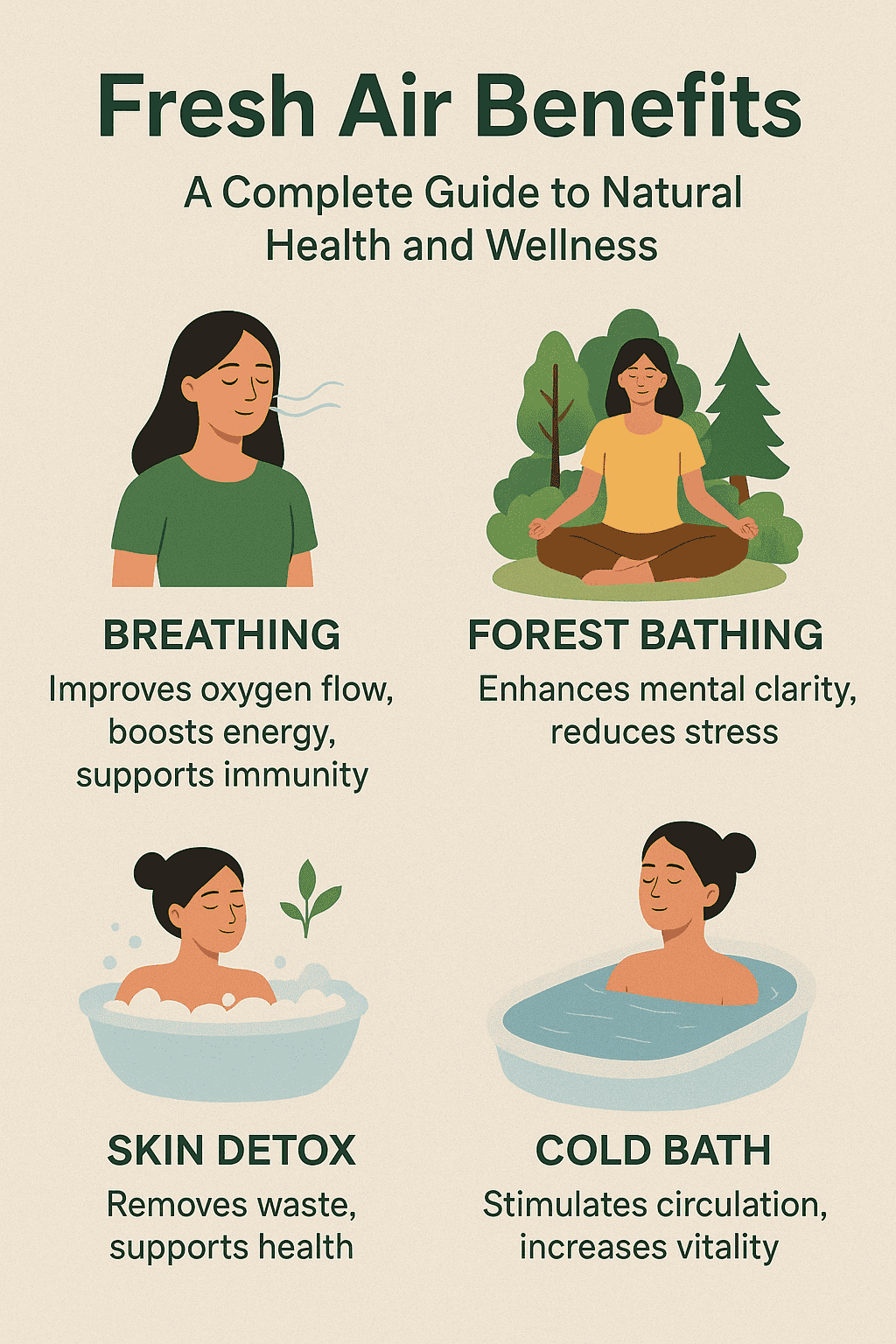
Your body’s relationship with air quality determines your baseline health in ways most people never consider. Fresh outdoor air contains approximately 21% oxygen and minimal carbon dioxide, while indoor air gradually becomes oxygen-depleted and accumulates carbon dioxide, volatile organic compounds from furniture, and recycled pollutants. Every cell in your body requires continuous oxygen to fuel metabolic processes, a primary driver of cellular energy production.
Urban environments present unique challenges. Vehicle emissions, industrial pollutants, and ozone create are toxic and directly impacts respiratory function and cardiovascular health. Studies show that people living in high-pollution areas experience 15-20% reduced lung capacity compared to those in cleaner environments. Conversely, forest environments offer concentrated phytoncides.
Phytoncides are natural compounds released by trees that boost immune function and reduce stress hormones by up to 12%.
The contrast becomes stark when you compare different settings: a congested city street might contain only 18% oxygen with elevated particulate matter, while a forest environment maintains optimal oxygen levels (21%) plus therapeutic compounds from vegetation. Your body recognizes this difference immediately. Consequently, sharper thinking, deeper breathing, increased energy, and enhanced mood which all signal proper oxygenation.
Modern indoor spaces trap more than just stale air. Carbon dioxide accumulates in closed rooms, acting as a subtle asphyxiant that dulls cognitive function, creates fatigue, and impairs all elimination processes. Opening windows isn’t just about comfort—it’s about preventing toxic buildup that your body cannot process efficiently.
Forest Bathing Guide: Step-by-Step Shinrin-Yoku Practice
Forest bathing, or shinrin-yoku, originated in Japan during the 1980s as a preventive health practice. Unlike hiking, which focuses on physical exertion and destination, forest bathing emphasizes slow, mindful immersion in nature’s atmosphere. The fresh air benefits are increased when combined with this intentional practice.
How to Practice Forest Bathing
Step 1: Choose Your Location Select a forested area, park, or any space with abundant trees and vegetation. Urban parks work perfectly and you don’t need wilderness. Look for locations with:
- Dense tree coverage (evergreens release more phytoncides)
- Minimal human noise and traffic
- Natural water features when possible (streams, ponds)
- Safe, accessible walking paths
Step 2: Prepare Mentally Leave all devices behind or silence them completely. Set an intention to disconnect from productivity and simply receive what nature offers. Release any goals or expectations—this isn’t about fitness metrics or achieving anything.
Step 3: Begin Walking Slowly Enter your chosen space and immediately slow your pace to about one-third of normal walking speed. Let your body wander naturally rather than following a predetermined route. Walk for 10-15 minutes to transition from your busy mind into present awareness.
Step 4: Engage Your Senses Sequentially Spend 5-10 minutes with each sense:
- Sight: Notice light patterns through leaves, color variations, textures of bark
- Sound: Listen to rustling leaves, bird calls, wind, water, silence between sounds
- Touch: Feel bark texture, soft moss, cool air against skin, earth beneath feet
- Smell: Inhale tree scents, earth, flowers, moisture in air
- Taste: If safe, taste edible plants, or simply notice how fresh air tastes different
Step 5: Find Your Sit Spot Select a comfortable location where you feel drawn to rest. Sit for 20-30 minutes without agenda. Observe thoughts arising and passing like clouds. Notice how your breathing naturally deepens and slows.
Step 6: Close With Gratitude Before leaving, take a moment to acknowledge the forest’s gifts. Notice how your body feels different—calmer nervous system, clearer mind, deeper breath capacity.
Optimal Duration: 2-3 hours provides maximum benefits, though even 15-20 minutes delivers measurable stress reduction. Practice weekly or monthly depending on your schedule.
Best Locations for Forest Bathing
- Evergreen forests: Release highest concentration of immune-boosting phytoncides
- Near water: Adds negative ions that enhance mood and clarity
- Morning hours: Air quality peaks, fewer people, bird activity increases
- Local parks: Accessibility matters more than wilderness isolation
Research demonstrates that regular forest bathing decreases cortisol (stress hormone) by 12-16%, lowers blood pressure by 5-7%, and increases natural killer cell activity—a key immune function marker—by 40-50%. These effects can last 3-5 days after a single session.
Seasonal Guide: Adapting Fresh Air Practices Year-Round
The fresh air benefits remain available regardless of season, but your approach should adapt to maximize comfort and safety while maintaining consistent practice.
Winter Fresh Air Practices
Cold air contains more oxygen molecules per breath than warm air, making winter potentially the most invigorating season for breathing practices. Layer clothing strategically—keep your core warm while allowing skin to breathe through natural fibers. Practice cold air breathing through your nose to warm and humidify air before it reaches lungs.
Winter-Specific Tips:
- Short, frequent outdoor sessions (10-15 minutes) beat long, infrequent exposure
- Morning light exposure combats seasonal affective disorder
- Post-outdoor hot bath maximizes circulation benefits
- Keep bedroom windows cracked even in freezing temperatures
Spring Fresh Air Practices
Spring offers peak oxygen production as plants emerge from dormancy. However, pollen can challenge sensitive respiratory systems. Early morning or post-rain periods provide clearest air quality.
Spring-Specific Tips:
- Practice after rainfall when pollen settles
- Focus on breathing exercises that clear sinuses
- Increase outdoor time gradually as body acclimates
- Explore blooming areas for aromatherapy benefits
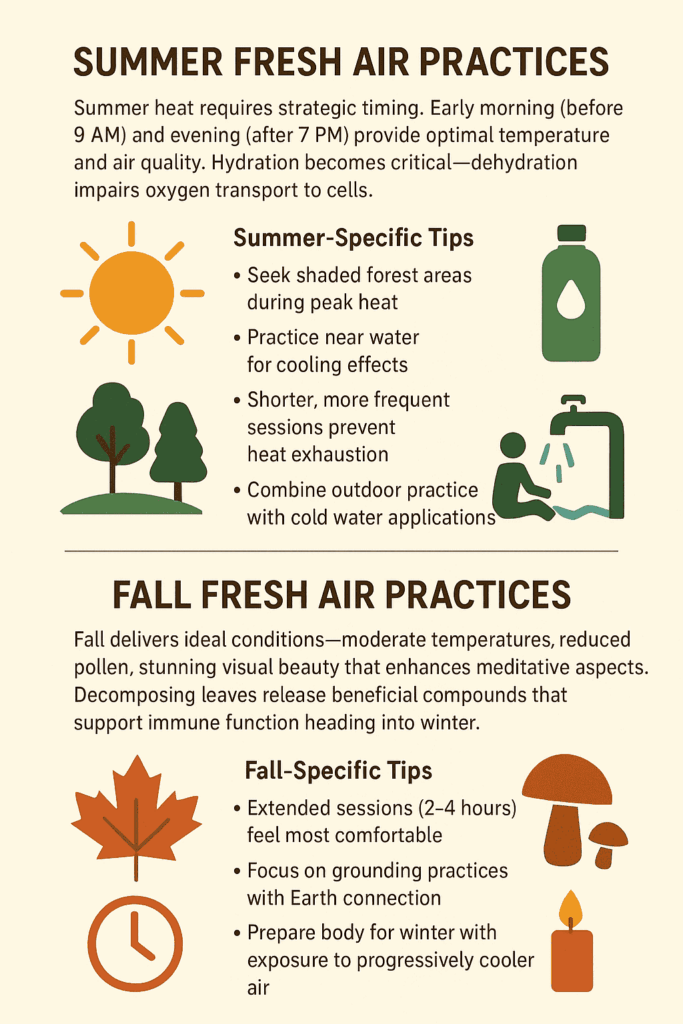
Summer Fresh Air Practices
Summer heat requires strategic timing. Early morning (before 9 AM) and evening (after 7 PM) provide optimal temperature and air quality. Hydration becomes critical—dehydration impairs oxygen transport to cells.
Summer-Specific Tips:
- Seek shaded forest areas during peak heat
- Practice near water for cooling effects
- Shorter, more frequent sessions prevent heat exhaustion
- Combine outdoor practice with cold water applications
Fall Fresh Air Practices
Fall delivers ideal conditions—moderate temperatures, reduced pollen, stunning visual beauty that enhances meditative aspects. Decomposing leaves release beneficial compounds that support immune function heading into winter.
Fall-Specific Tips:
- Harvest seasonal awareness for indoor visualization during winter
- Extended sessions (2-4 hours) feel most comfortable
- Focus on grounding practices with Earth connection
- Prepare body for winter with exposure to progressively cooler air
Breathing Techniques: Maximize Fresh Air Benefits
Proper breathing technique determines how effectively you absorb oxygen and eliminate carbon dioxide. Most people use only 30-40% of lung capacity through shallow chest breathing. These exercises teach full diaphragmatic breathing that maximizes the fresh air benefits.
Technique 1: Diaphragmatic Breathing (Foundation Practice)
This fundamental technique engages your diaphragm fully, increasing oxygen intake by 50-70% compared to chest breathing.
Practice:
- Sit or lie comfortably with one hand on chest, one on belly
- Inhale slowly through nose for 4 counts, expanding belly (not chest)
- Pause for 2 counts at top of breath
- Exhale through nose or mouth for 6 counts, belly deflating completely
- Repeat 10-15 cycles, twice daily
Benefits: Activates parasympathetic nervous system (rest-and-digest), reduces anxiety by 25-30%, improves oxygen saturation, supports skin detoxification through bathing by enhancing circulation.
Technique 2: Box Breathing (Stress Regulation)
Used by military personnel and first responders to maintain calm under pressure. This balanced breathing pattern regulates nervous system response immediately.
Practice:
- Inhale through nose for 4 counts
- Hold breath for 4 counts
- Exhale through nose for 4 counts
- Hold empty for 4 counts
- Repeat 5-10 rounds
Benefits: Reduces cortisol within 3-5 minutes, enhances focus and decision-making, balances CO2 levels, prepares body for restful sleep.
Technique 3: Alternate Nostril Breathing (Balance & Clarity)
This yogic technique balances left and right brain hemispheres while deeply calming the nervous system.
Practice:
- Sit comfortably with spine straight
- Use right thumb to close right nostril
- Inhale slowly through left nostril for 4 counts
- Close left nostril with right ring finger, release right nostril
- Exhale through right nostril for 4 counts
- Inhale through right nostril for 4 counts
- Switch: close right, exhale through left
- Complete 5-10 full cycles
Benefits: Improves respiratory efficiency by 20-25%, enhances mental clarity, reduces blood pressure, supports optimal sleep when practiced before bed.
Technique 4: Energizing Breath (Morning Practice)
This rapid breathing technique increases oxygen delivery and energizes body and mind—perfect for replacing morning caffeine.
Practice:
- Stand with feet hip-width apart
- Take deep breath in, raise arms overhead
- Exhale forcefully through mouth with “ha” sound, dropping arms
- Repeat rapidly 20-30 times
- Finish with 3 slow, deep breaths
Benefits: Increases circulation immediately, clears mental fog, stimulates lymphatic drainage (enhancing skin detoxification through bathing), boosts energy without stimulants.
For those wanting to explore deeper breathwork practices, mastering deep breathing techniques for health offers comprehensive guidance on using breath as medicine.
Skin Detoxification Through Bathing: Your Body’s Hidden Elimination System
Your skin eliminates waste equal to much of what your digestive system removes daily—yet most people never consider optimizing this crucial detoxification pathway. Millions of pores continuously discharge metabolic waste, and modern clothing prevents complete evaporation, causing partial reabsorption of toxins. Learn more on our blog on laws of organ of the senses for practical guide.
Hot Water Baths: Primary Detoxification Method
Hot water remains the only truly effective cleansing agent for skin. The combination of heat, soap, and mechanical friction (using a natural bristle brush) removes accumulated waste deposits, opens pores fully, and stimulates circulation that enhances elimination, as outlined on the article on morning bath benefits for health and energy.
Optimal Hot Bath Protocol:
- Water temperature: 100-104°F (38-40°C)
- Duration: 15-25 minutes
- Use natural soap and body brush
- Scrub entire body vigorously, focusing on areas with concentrated sweat glands
- Practice daily during detoxification, 3-4 times weekly for maintenance
The process of skin detoxification through bathing becomes especially critical during illness, fasting, or high-stress periods when your body eliminates with increased intensity. Body odor intensifies during these times—clear evidence of the massive waste elimination occurring through your pores.
Clothing and Skin Breathing
Your skin requires oxygen and must expel carbon dioxide just as your lungs do. Synthetic fabrics and tight clothing create barriers that impede this respiratory function. Choose natural fibers—cotton, linen, or silk—with loose weaves that allow air circulation. For more comprehensive guidance on this often-overlooked health factor, explore how clothing choices affect your well-being.
Benefits of Cold Baths: Strategic Application for Vitality
The benefits of cold baths differ entirely from hot water cleansing. Cold baths acts as tonic stimulation for your nervous and circulatory systems rather than a cleansing agent. Applied correctly, cold water strengthens vitality; applied incorrectly, it depletes energy reserves.
When Cold Baths Benefit
Cold water application provides genuine benefits only when your body responds with immediate reactive warmth and exhilaration. If you experience chilling, shaking, or depletion afterward, the cold application harms rather than helping. Your body’s reaction reveals everything, therefore, forcing cold exposure when your body cannot handle it drains vitality rather than building it.
Optimal Cold Bath Protocol:
- Best time: Early morning when vitality peaks
- Temperature: Start tepid (70-75°F), gradually lower over weeks
- Duration: 30 seconds to 3 minutes maximum
- Method: Brief immersion or cold shower, followed immediately by vigorous towel drying
- Frequency: 3-4 times weekly for robust individuals only
The benefits of cold baths emerge for healthy individuals as enhanced circulation, strengthened nervous system tone, increased mental alertness, and improved resistance to environmental stress. Cold stimulus causes blood vessels to constrict initially, then dilate powerfully as warmth returns—this alternating action exercises your cardiovascular system and clears stagnant blood from extremities.
Who Should Avoid Cold Baths
During illness, fasting, pregnancy, or periods of depleted vitality, avoid cold baths entirely or apply only under professional supervision. Your system lacks the energy reserves to mount the reactive response that delivers benefits. Tepid or warm water substitutes appropriately during these times. Understanding your body’s unique needs leads to practices that build health rather than deplete it—a principle emphasized in holistic approaches to wellness.
Optimize Sleep Environment: Maximize Nighttime Fresh Air Benefits
Sleep represents your body’s primary regeneration period, when cellular repair, waste elimination, and nervous system restoration operate most efficiently. The fresh air benefits multiply exponentially during sleep, as your relaxed state allows deeper breathing and more complete cellular renewal. Mastering proper sleep hygiene is fundamental to creating the ideal restful environment for this vital regenerative process.
Create Optimal Air Circulation
Your sleeping quarters must maintain constant ventilation with outside air to ensure a continuous supply of fresh oxygen. Most people remain tragically ignorant of fresh air’s therapeutic value when applied continuously during sleep. Open at least one window year-round, regardless of outdoor temperature—ideally, keep every window in your sleeping room open for maximum air circulation. Optimizing your bedroom’s ventilation is a critical step, and our detailed guide on maintaining healthy lungs and proper ventilation provides a complete strategy to maximize this essential practice.
Sleep Environment Checklist:
- Minimum one window open at all times
- Ideal: Multiple windows for cross-ventilation
- Remove heavy curtains that block airflow
- Position bed away from direct drafts while maintaining room circulation
- Monitor that carbon dioxide you exhale escapes efficiently
Your healthy body tolerates cold and drafts far better than stale, oxygen-depleted air laden with exhaled carbon dioxide. Body warmth preserves itself through bed coverings, not through sealing yourself in stagnant air.
Minimize Sleep Clothing
Night clothing should consist of one light piece at most, and ideally nothing at all. Ancient cultures understood the “naked bed” principle—minimal clothing allows your skin to breathe freely, maximizing detoxification and the eliminative processes that intensify during sleep. This practice aligns with the core principles discussed in our clothing and health guide, as heavy pajamas trap moisture and waste against your skin, forcing reabsorption of toxins your body worked to expel.
Combine these sleep optimization practices with the breathing techniques learned earlier, and you create conditions for deep, restorative rest that determines your next day’s vitality. Many people experience shorter but more refreshing sleep when following these principles—this represents natural law functioning properly.
Health Improvements: Documented Benefits and Optimal Frequency
The evidence supporting fresh air practices, forest bathing, and proper sleep environment optimization continues growing. Here’s what research demonstrates:
Stress Reduction Metrics
- Forest bathing reduces cortisol by 12-16% after a single 2-hour session
- Effects last 3-5 days post-exposure
- Weekly practice provides sustained stress management without medication
- Combined with breathing exercises, stress reduction reaches 25-30%
Immune System Enhancement
- Natural killer cell activity increases 40-50% after forest exposure
- Phytoncides inhaled during forest bathing stimulate immune function
- Enhanced immunity persists 7-30 days after exposure
- Regular practitioners show 23% fewer sick days annually
Cardiovascular Benefits
- Blood pressure decreases 5-7% during and after nature exposure
- Heart rate variability improves, indicating better stress adaptation
- Circulation enhancement from cold water exposure strengthens heart function
- Combined practices reduce cardiovascular disease risk by estimated 15-20%
Mental Clarity and Cognitive Function
- Anxiety and depression symptoms decrease significantly with regular practice
- Oxygen-rich environments improve cognitive performance by 20-25%
- Forest bathing enhances focus and reduces mental fatigue
- Sleep quality improvements lead to 30-40% better memory consolidation
Optimal Practice Frequency
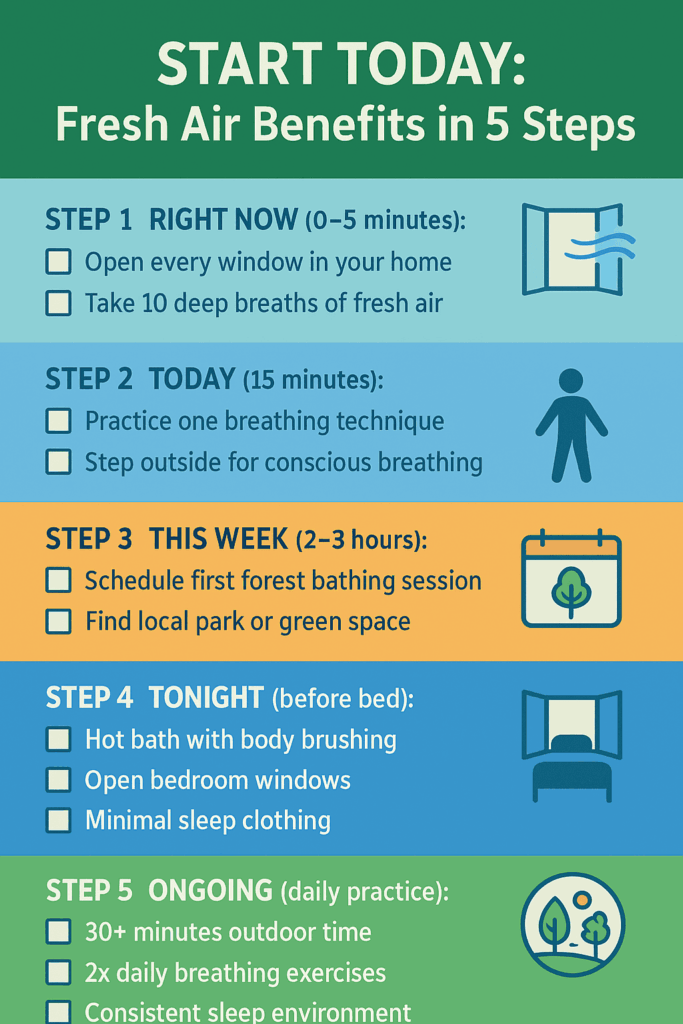
Fresh Air Exposure: Minimum 30 minutes daily outdoors, ideally 1-2 hours Forest Bathing: Weekly 2-3 hour sessions, or monthly extended practices Breathing Exercises: 10-15 minutes twice daily (morning and evening) Hot Water Bathing: Daily during detox, 3-4 times weekly for maintenance Cold Water Application: 3-4 times weekly for robust individuals only Sleep Environment: Every night with maximum ventilation
Building lasting vitality requires consistency across all these elements. The synergy between fresh air exposure, proper bathing practices, strategic breathing, and optimized sleep creates a comprehensive wellness system that addresses your body’s fundamental needs.
Conclusion
The fresh air benefits available to you cost nothing yet deliver transformative improvements to your energy, mental clarity, and immune function. By prioritizing oxygen for cellular energy, practicing intelligent skin detoxification, and optimizing your sleep environment for ventilation, you activate your body’s most fundamental healing pathways. This powerful combination works synergistically to cleanse your system and rebuild vitality from the inside out.
Your body possesses an innate wisdom that thrives when supported by these natural elements. Reconnecting with the essential practices of clean air and proper skin respiration doesn’t require complex protocols—only a consistent commitment to working with your body’s design.
Start reclaiming your natural health today: open your windows wide, breathe deeply, and honor your skin’s critical role in elimination. By fully embracing these fresh air benefits, you unlock the sustainable vitality that is your birthright.
For those seeking to deepen their wellness journey through complementary practices, explore our guides on nourishing nutrition for optimal health and holistic fasting approaches.
Frequently Asked Questions
How much time outdoors provides meaningful fresh air benefits?
Minimum 30 minutes daily delivers measurable improvements in mood, energy, and oxygen saturation. Optimal benefits emerge with 1-2 hours daily spent in natural environments. Even 10-15 minutes provides immediate stress reduction and mental clarity enhancement when practiced consistently.
Can I practice forest bathing in urban parks or only wilderness areas?
Urban parks provide significant benefits—research confirms that any green space with trees delivers therapeutic effects. While wilderness areas offer higher phytoncide concentrations, accessibility matters more than perfection. Your neighborhood park practiced weekly beats distant forests visited rarely.
What’s the difference between hot and cold water for skin detoxification through bathing?
Hot water opens pores, softens waste deposits, and provides the only truly effective cleansing method for skin detoxification. Cold water serves as nervous system tonic and circulatory stimulant but doesn’t cleanse effectively. Use hot water with soap and brushing for detoxification, reserve cold application for those with robust vitality seeking tonic benefits.
Should I close windows in winter to stay warm?
Fresh air benefits during sleep outweigh comfort concerns—your healthy body tolerates cold far better than stale, carbon dioxide-laden air. Keep at least one window open year-round, using bed coverings for warmth rather than sealing yourself in stagnant air that compromises overnight regeneration.
How do I know if cold baths benefit or harm me?
Your body’s immediate reaction reveals everything. Genuine benefits manifest as immediate warmth spreading through your body and exhilaration following the cold application. If you experience chilling, shaking, or depletion afterward, cold baths drain rather than build your vitality. Start with tepid water and assess your honest response before progressing to colder temperatures.