
How to Do Sitting Meditation Without Getting Sleepy (Beginner-Friendly Guide)
Most people don’t fail at sitting meditation because they lack discipline—they fail because they’re unknowingly training their brain to fall asleep.
If you’ve ever closed your eyes, tried to focus, and drifted into drowsiness within minutes, you’re not alone—and you’re not doing it “wrong” in the way you think. The real issue is that most meditation advice ignores how your nervous system actually works.
In this guide, you’ll learn a practical sitting meditation technique that keeps your mind alert, your body relaxed, and your awareness stable—using choiceless awareness, hara-centered breathing, and a structured 49-minute method. This isn’t just another mindfulness meditation practice; it’s a system to build a sustainable daily habit without the struggle.
What Is Sitting Meditation (And Why Most People Get It Wrong)
Sitting meditation is a mindfulness practice where you remain physically still while observing your thoughts, breath, and sensations without reaction. But here’s what most people miss: the goal isn’t to force a blank mind. It’s to develop continuous, present moment awareness.
Unlike concentration-based meditation, where attention is narrowed to a single object, sitting meditation develops open awareness—training your brain to observe without control. This activates different neural pathways associated with cognitive flexibility and emotional regulation. Instead of rigidly forcing stillness, a truly effective sitting meditation technique works with your body’s natural physiology, leading to deeper mental clarity.
Discover the science-backed benefits of meditation for long-term brain health and emotional balance.
How to Set Up Sitting Meditation for Maximum Focus
Your environment directly affects the quality of your sitting meditation technique. A poorly lit room or uncomfortable posture can trigger drowsiness before you even begin. This setup creates the right physiological conditions for alert, deep awareness—the single most overlooked factor in a successful mindfulness meditation practice.
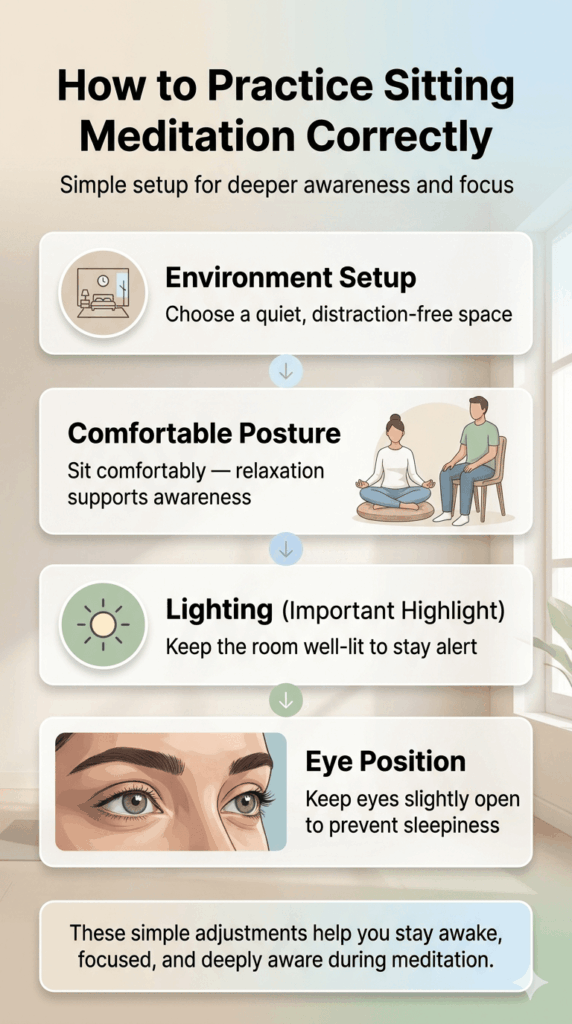
Two critical setup rules:
- Keep the room well-lit — natural or soft artificial light keeps your nervous system alert and engaged
- Keep your eyes slightly open — even two small slits of light actively prevent your brain from entering sleep mode
These simple steps create the right physiological conditions for alert, deep awareness. They are the single most overlooked factor in beginner sitting meditation practice.
Why You Feel Sleepy During Sitting Meditation (And How to Fix It)
Drowsiness is the most common complaint in meditation—and it is completely fixable once you understand what causes it.
Why you feel sleepy during meditation:
- Closed eyes signal the brain to begin preparing for sleep
- Melatonin production increases, triggering drowsiness
- Heart rate slows and blood pressure drops, reducing full-body alertness
The solution is straightforward: keep your eyes slightly open, or ensure bright light passes through your closed eyelids. This small adjustment maintains physiological wakefulness without disturbing your relaxed, meditative state.
Pro Tip: If drowsiness hits mid-session, slightly increase room lighting and open your eyes a little more. This single adjustment can dramatically boost alertness within seconds.
The 49-Minute Sitting Meditation Technique Explained
Attempting to sit for long periods without structure is one of the main reasons people abandon their meditation practice. This beginner-friendly, proven technique eliminates that problem entirely.
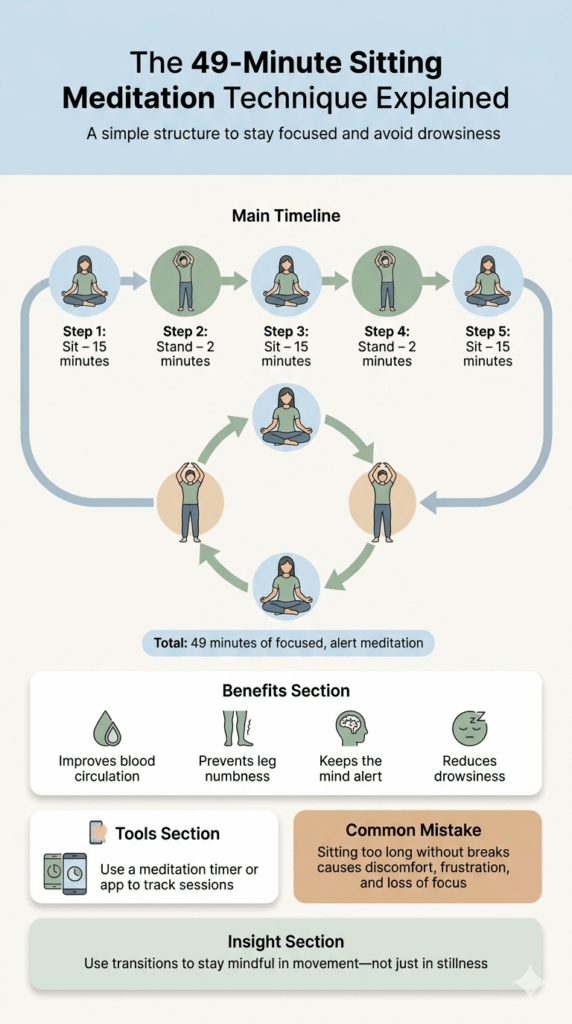
Structure your session like this:
- Sit for 15 minutes
- Stand for 2 minutes
- Sit for 15 minutes
- Stand for 2 minutes
- Sit for a final 15 minutes
Total: 49 minutes of focused, alert meditation.
The standing breaks restore blood circulation, eliminate leg numbness, and directly counter the light-sleep hypnosis that causes drowsiness. Use a meditation app like Insight Timer or a simple stopwatch to track transitions smoothly.
Common Mistake: Forcing yourself to sit for 45+ minutes straight leads to pain, frustration, and quitting—not deeper awareness. Work with your body, not against it.
The moments between sitting and standing are not wasted time. Use each transition to practice continuous mindful awareness while moving. This trains you to stay present throughout daily life, not only during formal sessions.
What Is Choiceless Awareness Meditation?
Choiceless awareness meditation is the practice of observing all thoughts, sounds, and sensations equally—without preference, judgment, or mental control.
Picture your awareness as a glass ball floating in open space. Sensory input flows through from every direction simultaneously. Rather than focusing on one object, you simply allow everything to arise and pass on its own.
In practice, this means:
- No forcing thoughts away
- No clinging to pleasant sensations
- No judging what arises—simply witnessing your experience as a detached observer
This state—sometimes called “one-object vision” by Zen practitioners—gradually dissolves the perceived separation between observer and observed. It is the methodless method that frees you from exhausting mental control.
Beginners can absolutely start with choiceless awareness meditation. Begin with simple open observation and let the technique deepen organically over time. When combined with hara-centered breathing, it becomes one of the most effective mindfulness meditation techniques available at any level.
Hara-Centered Breathing: How It Calms the Mind
Hara-centered breathing is a powerful, step-by-step method for quieting mental chatter without effort or force.
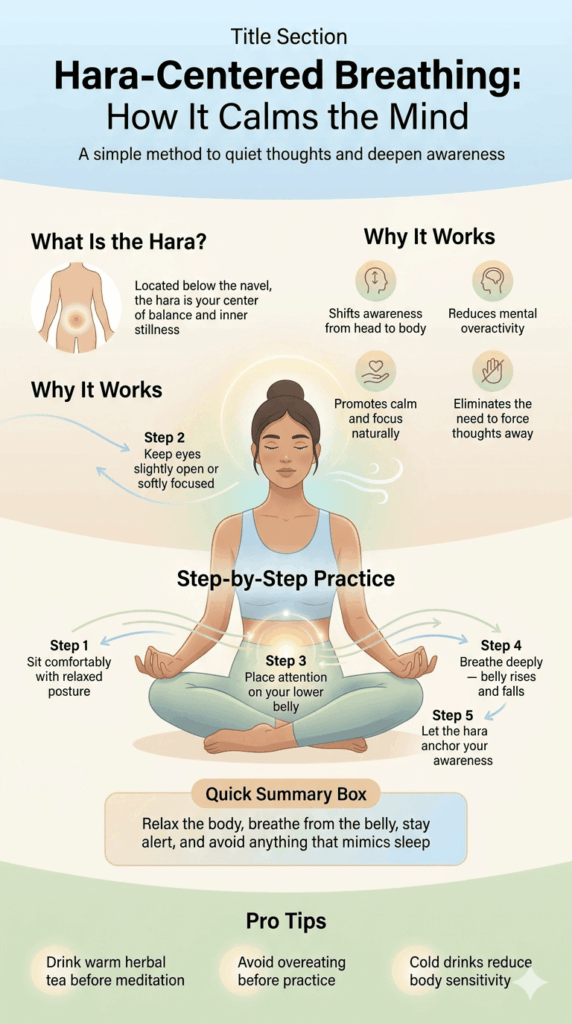
Locating the hara: The hara sits just below and behind your navel. Recognized across East Asian meditation and martial arts traditions, it is considered the body’s natural balancing point—the seat of vital energy and deep mental stillness.
When you consciously shift awareness from the busy head down into the hara, thinking naturally slows. Intrusive thoughts dissolve on their own, rather than being pushed away. This is the opposite of mental suppression, which typically makes thoughts more persistent.
How to practice hara breathing during sitting meditation:
- Sit comfortably and soften your gaze or allow a sliver of light through your eyes
- Place attention on your lower belly as it rises and falls with each breath
- Breathe naturally and deeply—belly-first, not chest-first
- Let the hara become the stable anchor of your awareness throughout the session
Quick Summary: Relax the body, breathe from the belly, keep the mind alert, and avoid anything—closed eyes, darkness, or mantras—that mimic the conditions of sleep.
Small preparations also make a difference. Drinking warm herbal tea before a session relaxes the gut and improves hara sensitivity. Overeating or consuming cold drinks beforehand makes hara awareness noticeably harder to access.
How to Stay Mindful Beyond Sitting Meditation
Real transformation happens when mindfulness extends beyond the cushion. The true goal of consistent sitting meditation is not just a calm session—it is awareness that carries through your entire day.
Carry your practice forward:
- Notice the breath during routine daily tasks
- Observe thoughts arising at work without engaging them
- Practice choiceless awareness while walking, eating, or doing chores
As your practice deepens, the boundary between “meditating” and “living” gradually fades. Awareness becomes your natural, default mode.
Frequently Asked Questions About Sitting Meditation
Why is sitting meditation better with eyes slightly open?
Sitting meditation with slightly open eyes prevents the brain from entering sleep mode. Fully closed eyes in a dark room trigger melatonin release, producing drowsiness rather than awareness. Even a thin sliver of light keeps your nervous system alert while your body remains deeply relaxed.
Why do I feel sleepy during sitting meditation, and how can I fix it?
Drowsiness during meditation is caused by closed eyes and reduced light signaling the brain to begin its sleep cycle. Keep the room well-lit, allow light through partially open eyes, and use the 49-minute technique with standing breaks to sustain full alertness throughout your practice.
Can beginners practice choiceless awareness meditation?
Yes. Choiceless awareness meditation requires no forced focus, making it surprisingly accessible for beginners. Simply observe whatever arises—thoughts, sounds, sensations—without preference or reaction. Combined with hara-centered breathing, it becomes one of the most effective meditation techniques for beginners and experienced practitioners alike.
How does hara-centered breathing improve sitting meditation?
Hara breathing shifts attention from the overactive mind down into the lower belly. This naturally quiets mental chatter, reduces overthinking, and grounds awareness firmly in the present moment—making your sitting meditation calmer, deeper, and far more sustainable long-term.
If you’re serious about mastering sitting meditation, start with just 15 minutes today using the 49-minute structure in this guide. Then deepen your practice by exploring our complete guide to sitting meditation practice and discover how to stay mindful—not just during formal sessions, but throughout your entire day.